

Casino Stop-Loss Rules in Plain Terms
Casino stop-loss rules come down to one routine. Fix a spending amount for the session before the first hand, play it in small stakes and stop when it runs out. In practice, the stop point is the moment that amount is gone, whatever the cards or the wheel have done in the meantime.

WHO observes that shame and stigma frequently keep people from asking for help with gambling problems, and that applies to readers of a real money casino guide as much as anyone. Someone embarrassed about a bad session gains most from a routine that was decided before play began, since it removes the need to explain anything to anyone.
Sizing a Loss Limit to Your Bankroll
A loss limit is sized from the money in the account. Balances, stakes and winnings are kept in Malaysian ringgit (MYR), so a limit written in that currency matches every stake placed.
A double-zero wheel carries a 5.26 percent edge on nearly every bet, and the five-number first-five bet sits higher at 7.89 percent. Between the two, the first-five bet costs more per spin, so it uses up a loss limit faster than an ordinary bet on the same wheel.
Hypothetical example: a player holds RM 2,000 and caps one session’s losses at 5% of that balance. The arithmetic is 2,000 × 0.05 = 100, so the session ends after RM 100 of losses. Across 4 sessions in a week, 100 × 4 = 400, which is RM 400 at most for the week.
What the WHO Says About Gambling Harm
According to WHO, money earned through crime is often cleaned by passing it through gambling. The concern is about where the money comes from, and it describes gambling as an activity in general, not any one operator.
WHO estimates that harm from gambling, at some level, reaches 11.9 percent of men and 5.5 percent of women worldwide. It counts harm at any level.
For someone in distress, Befrienders Kuala Lumpur takes calls on +603 7627 2929 for free, in confidence, 24 hours a day.
Games With a Smaller House Edge
In the house edge table kept by Wizard of Odds, single zero roulette is at 2.70%, double zero roulette sits at 5.26%, and sic bo covers everything from 2.78% to 33.33%. Sic bo has the widest spread of these entries, so the choice of bet matters more there than on the roulette wheels.
Blackjack is the low-edge example in live casino tips for beginners: Wizard of Odds puts it at a 0.28% house edge when liberal Las Vegas rules apply, which is below most casino games.
Baccarat sits at 1.06% for a Banker bet in that table, while Player is 1.24% and the Tie bet is 14.36%, the largest of the baccarat edges by a wide margin.
Some casinos run la partage on roulette: when the ball lands on zero, half of the stake on an outside wager is refunded. Outside wagers here means red or black, odd or even, and the low or high halves of the wheel. The refund softens the cost of the zero.
Roulette treats zero as neither even nor odd, so an even or odd bet does not win on that result.
Blackjack Rules That Move the Edge
Doubling after a split means doubling the stake on a hand that came from splitting a pair. A table that disallows it adds about 0.12% to the house edge.
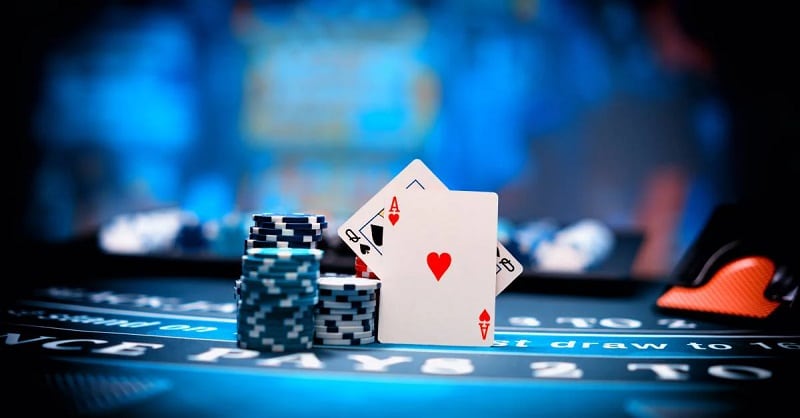
Paying 6:5 on a blackjack instead of 3:2 adds roughly 1.4% to the house edge. Of the two rule changes covered so far, the payout ratio moves the edge more than the doubling restriction does.
The choices on a hand depend on how many cards it holds:
- Opening two cards: surrender, split, double down, stand or hit.
- Any later card: hit or stand only.
Taking a third card therefore narrows the menu to hit or stand. Surrender is a choice on the opening decision only.
Choosing surrender costs half the stake and the hand ends on the spot. Some tables offer it and others do not, and it is off the table once a hand has been split.
Signs a Session Has Turned Into Chasing
According to WHO, the ICD-11 definition of gambling disorder rests on impaired control, gambling taking priority over other interests, and carrying on despite harm. A session that carries on after the planned amount is gone matches the first of those features, impaired control, even if it is a single evening.
Another sign on the WHO list is gambling money that should have gone to essential household spending, and WHO counts it as harm even when the person falls below clinical thresholds. Money taken from rent or food is a clearer warning than any win or loss streak.
A rigid playing rule can be costly in a different way. A 3.91 percent house edge is the cost of the never-bust strategy, where a player will not hit on a hard total of 12 or higher. That figure sits well above the blackjack number quoted earlier, so a rule that feels cautious can still be expensive.
Where Cashback Fits Into a Loss Limit
Every day, 0.7% of net losses across live casino, electronic and table titles comes back automatically, and no ceiling applies. A daily return is a refund on losses already made, so it belongs after the stop point rather than before it.
Live casino players who finish a week with a net loss receive an 8% relief bonus on it, with no cap. It covers baccarat, roulette, dragon tiger, sic bo and blackjack tables, and the current rates are listed under this month’s offers. Both returns are paid on losses, so neither one changes the amount a player has decided to risk.
Bonus funds also lose value through play: an assumed house edge of 5 percent applied to 150 of required bets gives an expected loss of about 7.50. It still shows that wagering requirements carry a cost.
Hypothetical example: a player sets a weekly stop point of RM 400 and loses RM 150 on Monday. The arithmetic is 150 + 250 = 400, so RM 250 remain before the stop point is reached.
Getting Help and Self-Exclusion
Casino play is for adults aged 18+. For a player who wants a firm stop, the 24/7 support team can arrange deposit limits, set daily, weekly or monthly, and self-exclusion, in line with responsible gambling.
WHO lists self-exclusion and binding limits on both time and money as tools for controlling or stopping gambling. A stop-loss rule written down in advance works the same way as a binding limit, since it is fixed before play begins.